The Driveway Dispute: Inside the Gordie Howe Bridge Geopolitical Standoff
The inside story of the 2026 Gordie Howe International Bridge negotiations. How a presidential threat and a toll dispute nearly blocked North America's most critical trade corridor.

Jonathan Cecil
Editor
Abstract
The Gordie Howe International Bridge connects Windsor, Ontario to Detroit, Michigan; in mid-2026, it became the center of a U.S.-Canada standoff. Even though Canada paid 100 percent of the bridge's C$6.4 billion cost, the U.S. used its control over border approval to delay the opening until Canada agreed to share toll profits early and accept limits on future toll increases. Using a "driveway" analogy between two neighbors, this piece breaks down how that pressure worked, what it actually cost Canada, and what it means for future cross-border infrastructure deals.
Introduction
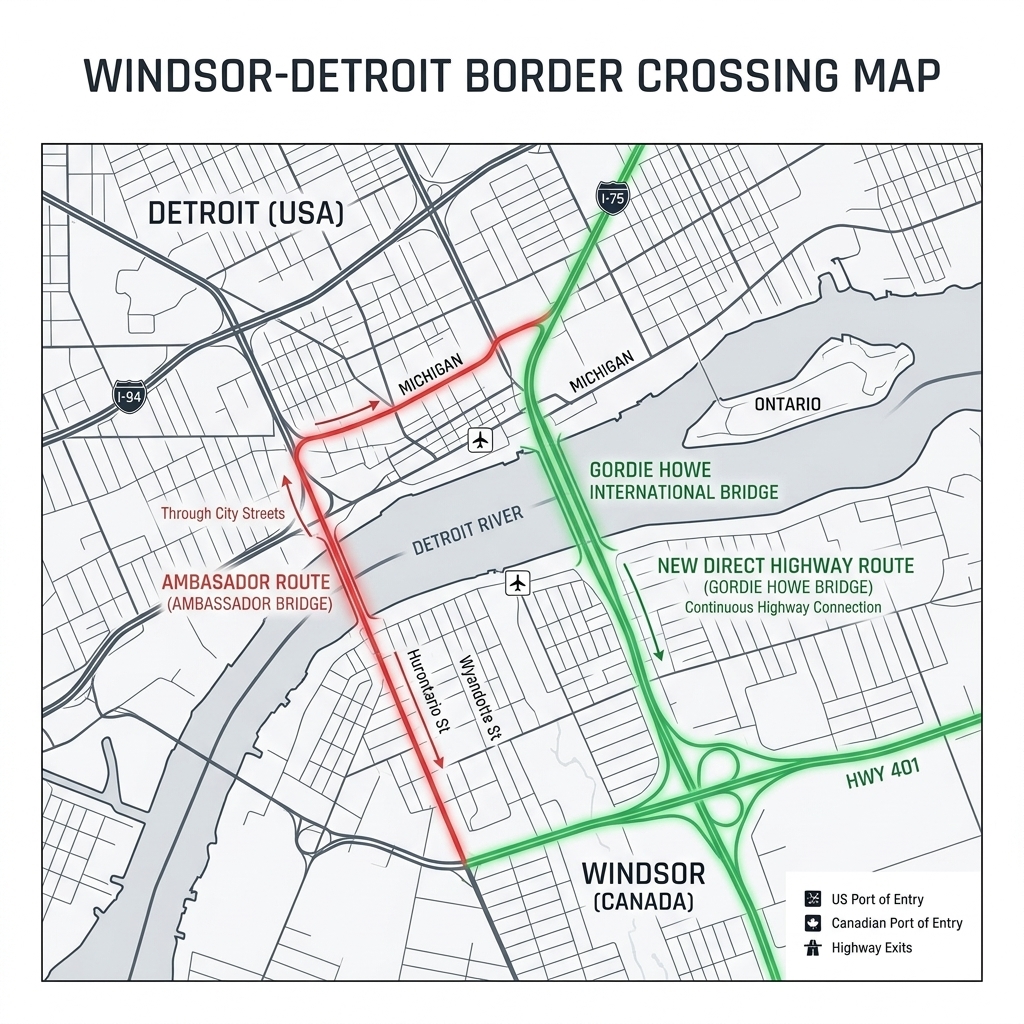
The Windsor-Detroit corridor carries 25 percent of all land-based trade between the U.S. and Canada, worth over $70 billion a year. For decades it relied on the privately owned Ambassador Bridge a monopoly worth roughly US$300 million a year in tolls that kept costs high and capacity limited. To fix this, Canada and the U.S. built the Gordie Howe International Bridge: a 2.5 kilometer, six-lane crossing linking Highway 401 in Ontario directly to Interstate 75 in Michigan.
The crossing matters because car parts often cross the border up to six times during assembly, so even short delays can stall factories on both sides. Skipping Windsor's city streets entirely, the new bridge saves trucks about 15 minutes per trip.
The 2012 Deal: A Driveway Built on Credit
Under the original 2012 Crossing Agreement, Canada agreed to finance 100 percent of the bridge's C$6.4 billion construction cost. In exchange, Canada would keep 100 percent of toll revenue until that debt was paid off or "amortized" like a mortgage, a process expected to take about 50 years. Only after the debt was cleared would toll profits split 50/50 with the State of Michigan, which co-owns the crossing.
In neighbor terms: Neighbor C (Canada) pays the entire $100,000 to build a shared driveway using a loan, while Neighbor A (America) pays nothing. Neighbor C keeps every toll dollar until the loan is paid off, and only then do the two neighbors start splitting future profits evenly.
Governance and the Standoff
Getting the bridge built required navigating years of binational approvals and fierce opposition from the Ambassador Bridge's owners:
Crossing Agreement
PM Harper and Gov. Snyder sign Canada-Michigan Agreement. Canada funds 100% upfront; asset is co-owned 50/50.
WDBA & Buy America
Windsor-Detroit Bridge Authority established. FHWA grants Buy America waiver allowing dual-sourced steel.
Contract Awarded
Bridging North America consortium begins 36-year DBFOM concession.
Pandemic Escalation
COVID delays push completion to 2025/2026. Total contract value rises to $6.4B CAD.
Political Offensive
Ambassador Bridge owner Matthew Moroun lobbies Lutnick. Trump threatens to block opening, claiming exploitation.
Clearance Halted
Washington blocks CBP operational clearance at Port of Entry, scuttling the ribbon-cutting ceremony.
Bridge Commissioned
Canada and U.S. sign revised side pact. U.S. gets 15-year 50/50 profit split. Bridge opens July 27.
Crossing Agreement
PM Harper and Gov. Snyder sign Canada-Michigan Agreement. Canada funds 100% upfront; asset is co-owned 50/50.
WDBA & Buy America
Windsor-Detroit Bridge Authority established. FHWA grants Buy America waiver allowing dual-sourced steel.
Contract Awarded
Bridging North America consortium begins 36-year DBFOM concession.
Pandemic Escalation
COVID delays push completion to 2025/2026. Total contract value rises to $6.4B CAD.
Political Offensive
Ambassador Bridge owner Matthew Moroun lobbies Lutnick. Trump threatens to block opening, claiming exploitation.
Clearance Halted
Washington blocks CBP operational clearance at Port of Entry, scuttling the ribbon-cutting ceremony.
Bridge Commissioned
Canada and U.S. sign revised side pact. U.S. gets 15-year 50/50 profit split. Bridge opens July 27.
Construction finished in June 2026, but just as the bridge was ready to open, the U.S. blocked it. Citing readiness gaps at the American crossing, Washington held up final clearance from U.S. Customs and Border Protection (CBP), stalling the opening indefinitely. That hold-up is what forced Canada into the emergency negotiations below.
The Standoff, In Neighbor Terms
Return to the neighbors to see why this happened. Once the driveway is finished, Neighbor A blocks the gate and demands 50 percent of the profits immediately rather than in 50 years. Neighbor C, unable to leave a finished, multi-million-dollar driveway sitting idle, agrees to a 15 year side deal. But the new contract never specifies whether Neighbor C's loan payments count as a cost before splitting "profit," so each neighbor does the math differently:
| Metric / Scenario | Neighbor C (Canada Stance) | Neighbor A (U.S. Stance) |
|---|---|---|
| Initial Funding | Pays 100% of $100,000 construction cost | Pays $0 |
| Formula | Tolls - (Maintenance + Loan Payments) | Tolls - Maintenance |
| Annual Tolls | $12,000 | $12,000 |
| Maintenance | -$2,000 | -$2,000 |
| Loan Payment | -$10,000 (10% of debt) | Ignored (Neighbor C pays alone) |
| Net Profit | $0 | $10,000 |
| Annual Payout | $0 | $5,000 (50% of Net Profit) |
| Outcome | Neighbor C services the debt alone | Neighbor A collects $5,000/yr from day one |
This is exactly the ambiguity behind the real dispute: the July 2026 side deal that let the bridge open on July 27 never states whether Canada's debt payments come out before the 50 percent U.S. split is calculated.
What the Side Deal Actually Costs Canada
The bridge is projected to generate about C$158 million (US$115 million) a year in tolls, against C$34 million (US$25 million) in operating costs, leaving C$124 million (US$90 million) in net revenue. Under the U.S.'s reading (tolls minus operating costs, no debt deduction), a 50 percent split hands the U.S. fund C$62 million (US$45 million) a year, or C$930 million (US$675 million) over 15 years.
That diverted money does not come from a separate surplus; instead, it comes straight out of what would otherwise cover Canada's C$275 million-a-year debt payments. Before the side deal, tolls covered C$124 million of that bill, leaving taxpayers to cover the remaining C$151 million. After the side deal, tolls cover only C$62 million, so the taxpayer-funded share rises to C$213 million a year. Multiply that C$62 million gap by 15 years and you land back at the same C$930 million, just counted from the taxpayer's side of the ledger instead of the U.S. fund's.
In neighbor terms, Neighbor A's cut comes out of the money Neighbor C needs for its own loan payments, not a separate bonus pool, meaning Neighbor C's contribution must rise to cover it. The side deal added one more constraint: Canada cannot raise tolls more than 10 percent a year, or cut them below regional rates, without U.S. sign-off, protecting the Ambassador Bridge from price competition. A 2012 Buy America steel waiver was left unchanged, undercutting claims the dispute was ever really about steel.
Strategic Conclusions
The negotiations yield three conclusions:
- Uneven Risk: Canada carried all the financial risk, representing the C$6.4 billion construction debt, while the U.S. carried none yet still claimed a cut of future profits.
- Real Concessions: Through the 15 year revenue split and toll-rate veto, Canada gave up genuine money and pricing control, not just symbolic wins.
- Pragmatism Over Principle: Canadian negotiators chose to open the trade corridor quickly rather than fight the ambiguity in court, accepting a short-term cost to protect long-term supply chains.
About the Author

Continue Reading
The September Strike: Inside Canada's $27.6 Billion Retaliatory Tariff Plan
How Canada's dollar for dollar counter tariffs target key US congressional battlegrounds to force a trade de-escalation ahead of the midterms.
The Midnight Walkout: Why the US and Canada Trade Talks Collapsed
An inside look at how last minute demands on pickup trucks, Keystone XL, and Netflix algorithms caused the US and Canada trade talks to collapse.
The 72-Hour Tariff Truce: How US Pressure Fractured Canadian Federalism
How Prime Minister Mark Carney traded provincial liquor monopolies, dairy quotas, and pipeline diplomacy to shield Ontario manufacturing during US tariff talks.