Redesigning Middle East Trade: The Geopolitics and Physics of Bypassing the Strait of Hormuz
Redesigning Middle East Trade: The Geopolitics and Physics of Bypassing the Strait of Hormuz
Why pipelines and railways cannot replace the Strait of Hormuz: An analysis of the thermodynamic and geopolitical bottlenecks of the 2026 shipping crisis.

Jonathan Cecil
Editor
Abstract
An analysis of the geopolitical and physical constraints of bypassing the Strait of Hormuz during the 2026 shipping crisis, highlighting the LNG cryogenic bottleneck, the import cost penalties of land routes, and Oman's fragile neutrality.
Introduction: The Shipping Crisis of 2026
The February 28, 2026 war between the United States and Israel and Iran, initiated by Operation Epic Fury, disrupted Persian Gulf maritime security. Asymmetric retaliation from the Islamic Revolutionary Guard Corps (IRGC) closed the Strait of Hormuz, the world’s most critical energy choke point, halting shipping with speedboats, cruise missiles, and sea mines. Ceasefire attempts under the Islamabad Memorandum of Understanding have stalled due to disputes over transit authority and tolls. With eighty active sea mines and continued friction, Gulf Cooperation Council (GCC) states are fast-tracking overland trade and energy bypass routes.
💡 Quick Explainer: A choke point is a narrow waterway connecting larger seas. The Strait of Hormuz is the only exit from the Persian Gulf, trapping exports from Saudi Arabia, Iraq, Kuwait, Qatar, and the UAE if closed.
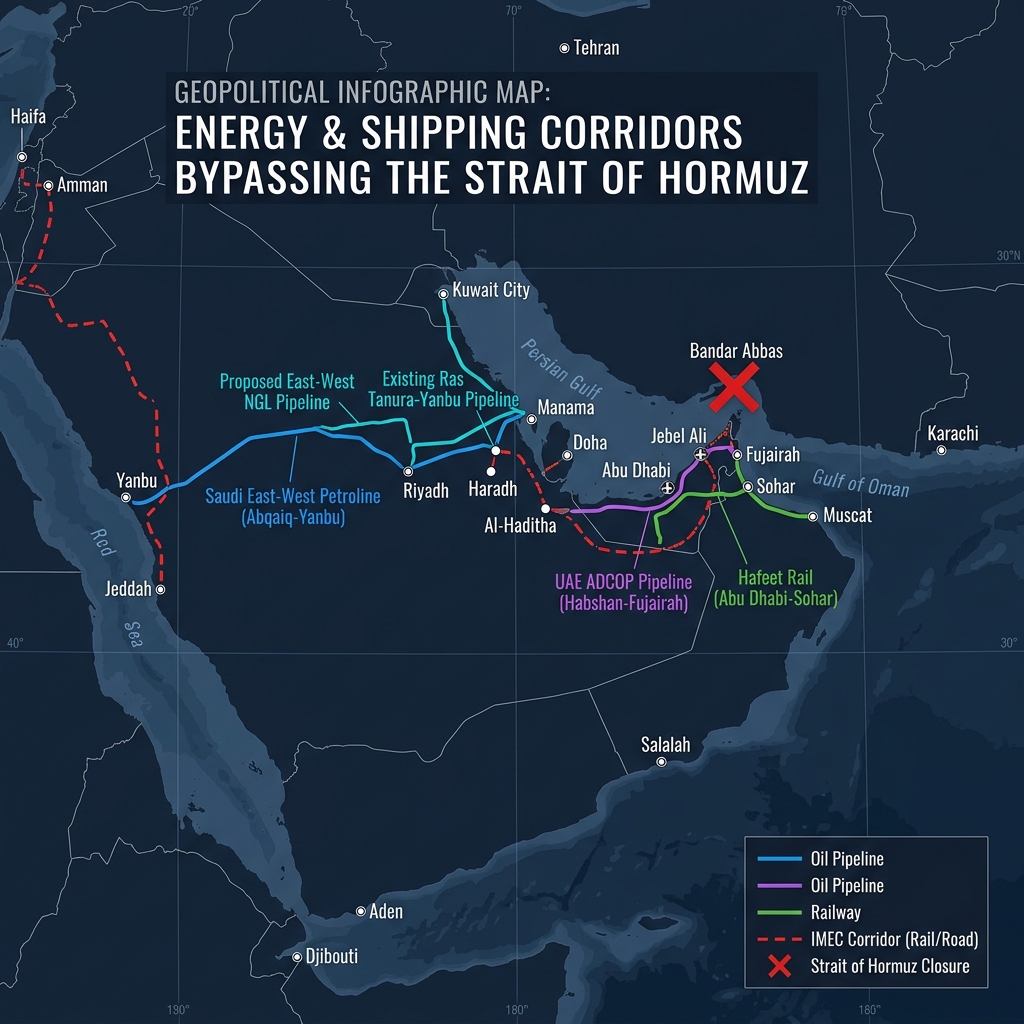
Geopolitical Redesign: The Infrastructure Arbitrage
1. Crude Oil vs. LNG: The Thermodynamic Constraint
The effort to bypass the Strait faces constraints dictated by geography and chemistry. While crude oil flows through terrestrial pipelines, Liquefied Natural Gas (LNG) is bound to maritime transport. Chilling natural gas to minus 162 degrees Celsius shrinks its volume by 600 times into a liquid state, requiring massive cryogenic facilities. Qatar's entire LNG infrastructure is concentrated at Ras Laffan inside the Persian Gulf. Bypassing the Strait requires raw gas pipelines through Saudi Arabia or Oman and new, multi-billion-dollar liquefaction plants outside the Gulf: a project carrying high cost and political risks. Consequently, closing Hormuz removes one-fifth to one-quarter of global LNG supply from the market, sending utility prices in Europe and Northeast Asia soaring.
💡 Quick Explainer: LNG (Liquefied Natural Gas) is natural gas cooled to a liquid for shipping. It requires specialized export liquefaction plants and import regasification terminals, making it impossible to reroute without massive coastal facilities.
For crude oil, Saudi Arabia's East-West Pipeline (Petroline) and the UAE's Abu Dhabi Crude Oil Pipeline (ADCOP) offer bypass channels to the Red Sea and Gulf of Oman. Under ADNOC, the UAE is accelerating the West-East 1 pipeline to double bypass capacity to 3.3 million barrels per day by 2027.
Combined bypass pipelines remain below 7 million barrels per day, leaving a structural deficit of over 13 million barrels per day during a total closure of the Strait.
2. Port Bottlenecks and the Import Cost Penalty
Exporting oil is only half the battle: GCC states must also import commercial goods. The primary container hubs, like Jebel Ali (handling 15.5 million TEUs annually), sit inside the Persian Gulf. Unloading at eastern ports like Fujairah or Khor Fakkan and shipping cargo overland across the Hajar Mountains introduces a steep import cost penalty.
💡 Quick Explainer: A TEU is a standard shipping container. Drayage is short-distance overland freight. Unloading containers outside the Gulf and hauling them overland by rail or road creates transport bottlenecks that raise consumer costs.
Oman's Salalah port has 3 million TEUs of latent capacity but lacks connecting freight rail, forcing expensive trucking. Duqm is situated outside the conflict zone, but turning it into a container hub is a three to five year project. Currently, Etihad Rail’s Fujairah link offers only 50,000 TEUs of annual relief capacity, compared to the 33 million TEUs transiting the Gulf.
3. Rail and Geopolitical Corridors
States are prioritizing the $250 billion, 2,177 kilometer GCC Railway. The joint venture Hafeet Rail will connect Sohar Port to Abu Dhabi via a 303 kilometer line, moving 15,000 tonnes of cargo per train.
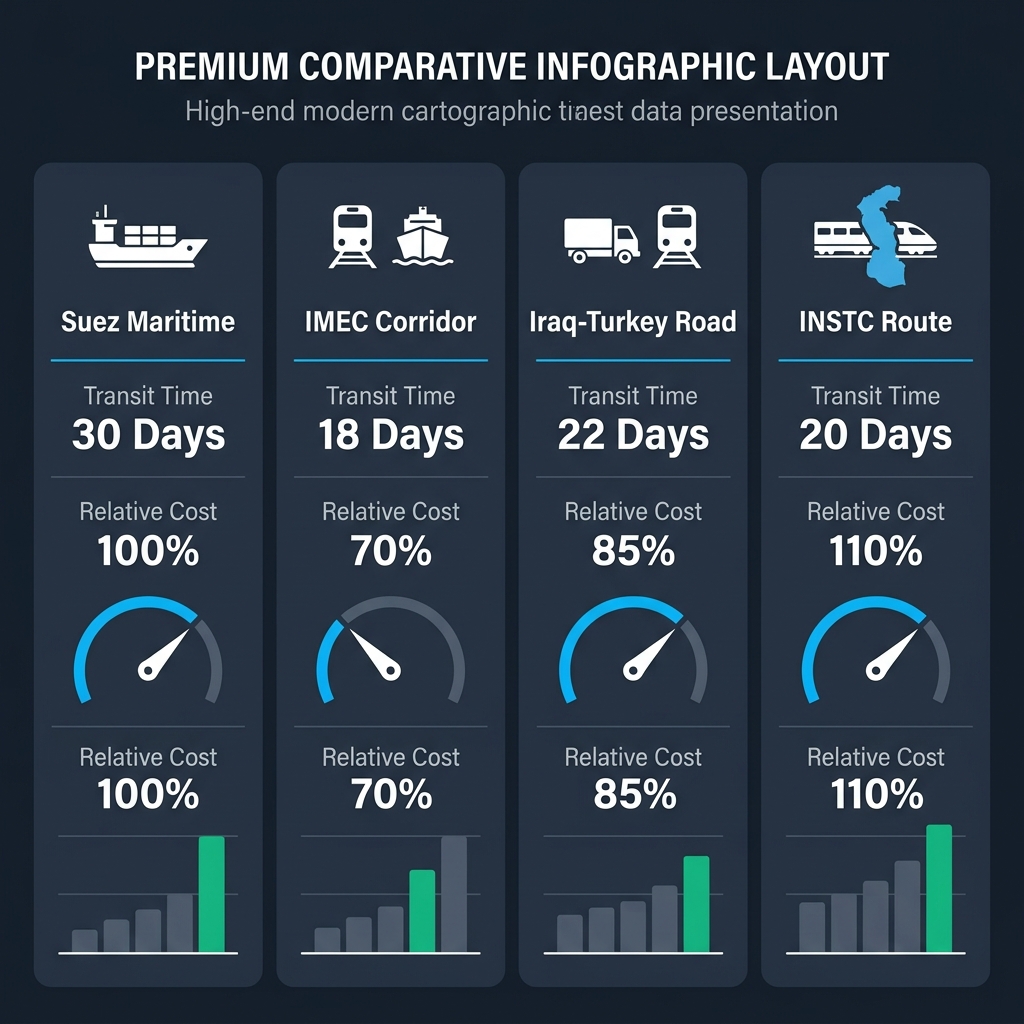
The crisis has renewed interest in the India-Middle East-Europe Economic Corridor (IMEC), routing cargo from India to the UAE, rail across Saudi Arabia and Jordan, and sea to Europe. These massive networks function as crucial geoeconomic hedges, allowing states to employ infrastructure diplomacy to tie regional stability directly to global supply chains. However, IMEC is on hold due to regional instability, funding gaps, and a 269 kilometer rail gap between the UAE and Saudi Arabia. Competitor routes, like the Iraq and Turkey Development Road and Russia's International North-South Transport Corridor (INSTC), also face security and regulatory hurdles.
4. The Sultanate of Oman: Neutrality under Strain
Oman's deep-water ports at Sohar, Duqm, and Salalah lie outside the Gulf. Muscat has maintained active neutrality, serving as a mediator between Iran, the United States, and Saudi Arabia. Under Sultan Haitham, this stance initially shielded Oman's infrastructure from strikes. Duqm is highly strategic, and the United States Navy has formal access to both Duqm and Salalah.
However, this balancing act has invited pressure. In May 2026, Tehran established the Persian Gulf Strait Authority, demanding Muscat join a joint tolling mechanism. Oman refused, citing free transit passage under the United Nations Convention on the Law of the Sea (UNCLOS), prompting drone strikes from Iranian-backed militias on Duqm and Salalah. This confrontation represents a classic legal conflict between sovereign coastal jurisdiction: as asserted by Iran: and global commons transit freedom, championed by Oman and its Western partners. The United States Treasury also threatened sanctions if Oman cooperated with Iran.
💡 Quick Explainer: UNCLOS is the international treaty governing oceans. Its transit passage rules grant all vessels the right to navigate international straits continuously and without interference, preventing coastal states from levying tolls.
Conclusion: The Strait's Persistent Grip
Overland rail, pipelines, and new ports improve regional logistics resilience, but they are not a complete replacement. The physical bottleneck of LNG and the cost penalty of overland drayage ensure that global markets remain dependent on the stability of the Strait of Hormuz.
About the Author

Continue Reading
War in the Middle East: Timeline of the US Israel Iran Conflict
This timeline tracks the US Israel Iran conflict from its opening strike through the June ceasefire, its July collapse and re-escalation, and the fragile new Doha truce, day by day.
Week 24: Iran's Five Ultimata and the Hormuz Lockout
Fact-based analysis of Day 162 (Saturday, August 8, 2026): Supreme National Security Council releases 5 demands, White House rejection, and 53 vessels redirected under US naval blockade.
Week 23: Omani Transit Talks and the ADNOC Missile Strike
Fact-based analysis of Week 23 (August 1 to August 7, 2026): Omani transit negotiations, depleted THAAD stockpiles, and ADNOC tanker missile strikes.